
Are Drones Allowed in Toronto? 2025 Update
On This Page
A practical breakdown of drone laws in Toronto, including airspace rules, park restrictions, and NAV CANADA requirements for 2025.
Last updated: November 4, 2025
2025 Update (effective Nov 4, 2025): Transport Canada has expanded Canada's RPAS rules. Advanced pilots can now request controlled airspace authorization through NAV Drone, and new Level 1 Complex (LC1) pathways, fees, and operational requirements are being phased in throughout 2025. Always confirm current rules with Transport Canada and NAV CANADA before flying.
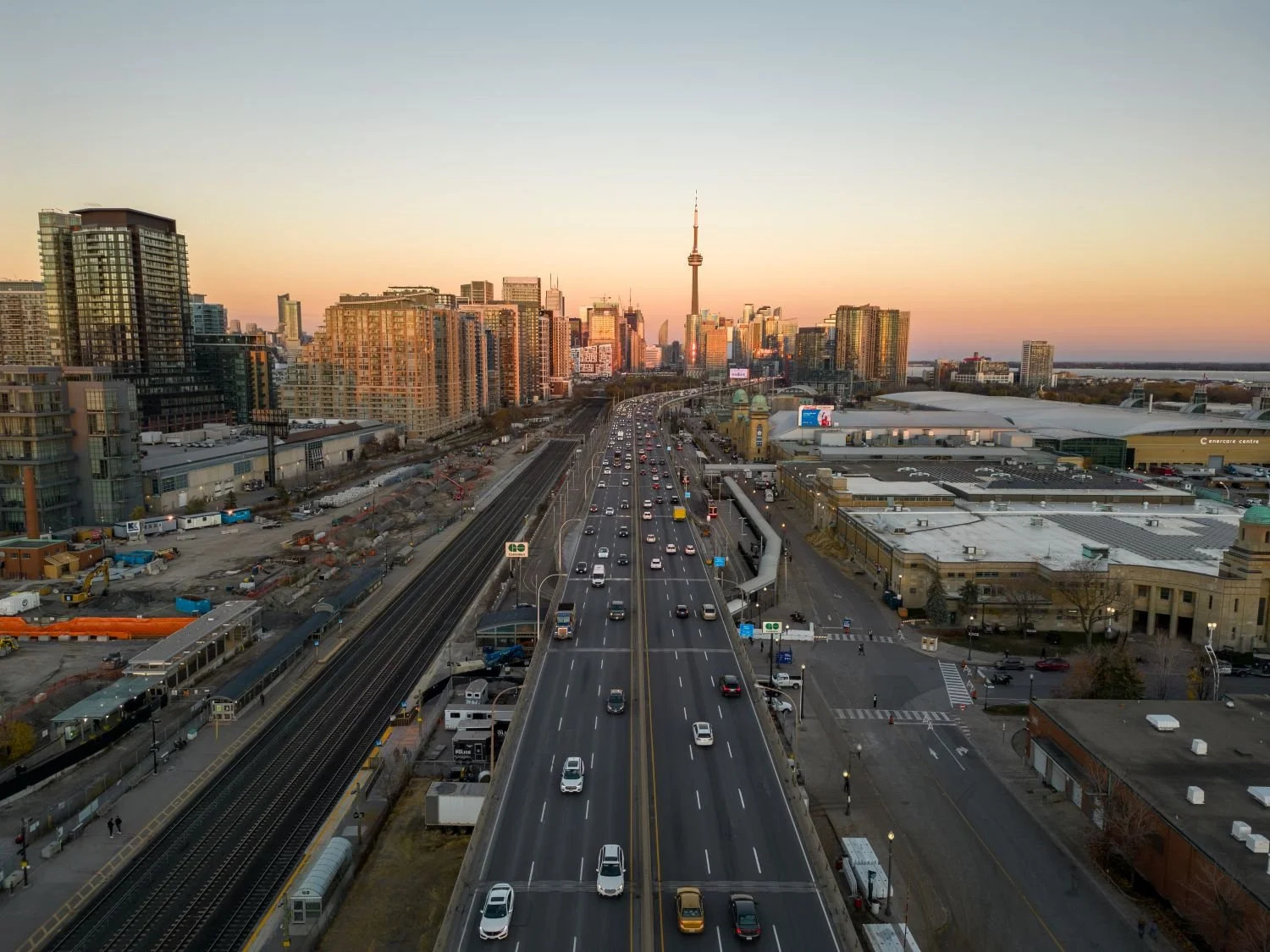
Aerial view of downtown Toronto captured by a drone, showcasing the city's skyline with its iconic skyscrapers and bustling streets. This image highlights the importance of drone operations within controlled airspace, emphasizing the need for drone pilots to adhere to Canadian aviation regulations for safe and responsible flying.
Important Legal Disclaimer The information contained in this guide is for general informational purposes only and is not legal advice. Drone regulations (RPAS rules) in Canada are constantly changing and are subject to interpretation by Transport Canada (TC), NAV CANADA, and local City of Toronto authorities. While we strive to ensure the information is accurate and up-to-date, we make no representation or warranty of any kind, express or implied, regarding the accuracy, adequacy, validity, reliability, availability, or completeness of any information provided. You are solely responsible for verifying the current rules and regulations with the appropriate authorities (Transport Canada, NAV CANADA, and the City of Toronto) before conducting any flight operation. Relying on any information in this article is strictly at your own risk.
Table of Contents
- Quick Answer: Can You Fly a Drone in Toronto?
- Overview: Why Toronto Is Uniquely Challenging
- Drone Laws in Toronto: Federal vs Municipal Rules Explained
- RPAS Categories in Canada: Why Drone Weight Matters
- Critical 2025 Update: Micro-Drones at Advertised Events
- Why "Under 250 g" Is Not a Get-Out-of-Regulation Card
- Toronto's Controlled Airspace: The First Major Challenge
- Where You Can and Can't Launch a Drone in Toronto
- Flying Over Lake Ontario and the Toronto Waterfront
- Downtown Toronto: Understanding the Restrictions
- Certification, Registration, and Insurance Requirements
- Fines and Penalties for Unauthorized Drone Activities
- How to Fly Legally in Toronto: Step-by-Step Guide
- Where to Find Official Rules and Support
- Conclusion
Quick Answer: Can You Fly a Drone in Toronto?
Short answer: Yes, drone flights are legal in Toronto, but only if you comply with both federal aviation law and City of Toronto bylaws. Most of Toronto is controlled airspace under NAV CANADA, and all City-owned parks and beaches prohibit drone takeoff and landing without a permit, which makes unplanned or recreational flying extremely limited.
Long answer: To fly drones safely and legally in Toronto, you need the correct drone pilot certificate, a registered aircraft (if 250 g or heavier), NAV CANADA approval for controlled airspace, and a lawful takeoff and landing location. If even one requirement is missing, the operation is not compliant, even if you are using a micro drone under 250 g.
As of 2025, new Transport Canada rules apply to micro drones at advertised events, and updated penalties, LC1 certification pathways, and controlled-airspace access rules are being phased in. Flying "safely" is not enough, you must fly legally under the Canadian Aviation Regulations and local land-use restrictions.
Overview: Why Toronto Is Uniquely Challenging
Toronto is not a beginner friendly place for drone flying. The city sits inside controlled airspace from two airports, four hospital heliports, and several active waterfront flight corridors. It also has densely populated ground areas and municipal bylaws that prohibit drone takeoff and landing on most public property. As a result, legal drone operations in Toronto require more planning and documentation than in most other Canadian cities.
Federally, drones are regulated as aircraft under the Aeronautics Act and CARs Part IX. Pilots must follow Transport Canada rules for licensing, registration, airspace access, and flight safety. But that’s only half the compliance picture.
Toronto adds a second layer of restriction: land use rules. Even if a flight is legal in the air, it can still be illegal on the ground if the pilot launches from a no drone zone such as a park, trail, greenspace or private property without a permit or written authorization.
Drone Laws in Toronto: Federal vs Municipal Rules Explained
Whether you're flying drones for real estate, construction monitoring, film production, or recreational use, every legal flight in Toronto must satisfy two completely different rule systems:
| Rule Layer | Who Controls It | What It Covers |
|---|---|---|
| Federal (Transport Canada) | Canadian aviation law under CARs Part IX | Licensing, RPAS category, Canadian airspace rules, flight distances, pilot certification (Basic vs Advanced) |
| Municipal (City of Toronto) | Local bylaws & property law | Where drones may take off and land, park restrictions, permits, enforcement |
This is why Toronto requires more planning than most other major Canadian cities, especially for commercial operations, advanced operations in class c airspace / controlled airspace, or work along the waterfront or downtown core.
RPAS Categories in Canada: Why Drone Weight Matters
Before looking at Toronto specific regulations, you need to understand how Transport Canada classifies Remotely Piloted Aircraft Systems (RPAS). The rules do not care whether you are flying commercially or recreationally, they are based entirely on the weight of the aircraft at takeoff.
| RPAS Category | Takeoff Weight | Registration Required? | Pilot Certificate Required? | Airspace Authorization? |
|---|---|---|---|---|
| Micro RPAS | Under 250 g | No | No | Not required for controlled airspace, but all bylaws, privacy laws, and Criminal Code still apply |
| Small RPAS | 250 g – 25 kg | Yes | Basic or Advanced (Advanced required for controlled airspace) | NAV Drone authorization required in controlled airspace |
| Medium RPAS | 25 kg – 150 kg | Yes | Advanced + Safety Assurance + (2025) LC1 requirements | Controlled airspace access begins Nov 4, 2025 with Level 1 Complex declaration |
2025 Update: Medium RPAS (25–150 kg) will be permitted in controlled airspace once the new LC1 (Level 1 Complex) pathway is active. Operators will need both Safety Assurance and declaration filing, this is a major change from previous exemptions.
Even though micro drones do not require registration or a drone pilot certificate, they are not exempt from:
CAR 900.06 (reckless or negligent operation)
Privacy laws and Criminal Code provisions
Laws about flying near advertised events (requires a Special Flight Operation Certificate)
Toronto's no drone zones (parks, trails, beaches, etc.)
Critical 2025 Update: Micro-Drones at Advertised Events
As of April 1, 2025, flying a micro drone (under 250 g) at an advertised event such as a parade, festival, sports event, or outdoor concert, requires a Special Flight Operations Certificate (SFOC-RPAS). There is no exemption based on weight.
249 g drone in an empty field = no SFOC required
249 g drone over a parade, stadium, street festival, or ticketed crowd = SFOC required
This applies nationwide, including Toronto, and is now one of the most common enforcement triggers at public events.
A 249 g drone can still lead to fines if flown from a prohibited location, over people, or inside an event zone.
Why "Under 250 g" Is Not a Get-Out-of-Regulation Card
Many drones marketed as "sub-250 g" can exceed the legal limit depending on batteries, prop guards, ND filters, accessories or even slight manufacturing variance in actual weight. Weighing over 250g turns the aircraft into a Small RPAS, which means:
| Under 250 g (Micro RPAS) | 250 g+ (Small RPAS) |
|---|---|
| No registration | Registration required |
| No pilot certificate | Basic or Advanced certificate required |
| No NAV Drone required in controlled airspace | NAV Drone approval required |
| Still subject to bylaws, privacy, Criminal Code | Full CARs Part IX rules apply |
Practical example: Early user tests of the DJI Mini 5 Pro showed some builds weighing 250–255 g without accessories installed, which legally makes it a Small RPAS, not a micro drone.
A difference of only 5 g can change whether a flight in Toronto is legal, requires certification, or violates controlled airspace rules.
Toronto's Controlled Airspace: The First Major Challenge
A large portion of the City of Toronto is situated within controlled airspace associated with the airports at Toronto Pearson International Airport (CYYZ) and Billy Bishop Toronto City Airport (CYTZ). While the exact boundaries vary, the inner-core and waterfront areas fall under tighter aviation control, which means additional drone-authorization steps apply.
For any drone 250 g or heavier, flying from or within controlled airspace triggers these federal operational requirements:
You hold an Advanced RPAS Pilot Certificate.
Your drone has a valid RPAS Safety Assurance (as declared by the manufacturer) that covers controlled-airspace operations.
You have received approval through NAV Canada’s authorization system, NAV Drone (ia NAV Drone app) to operate in that controlled zone.
You launch and land from a location where you have legal access (private property or an approved site), a municipal land-use permit might also be required.
If any one of these is missing, the flight is not compliant, even if it’s short, low-altitude, or appears “simple.”
Below is what Toronto’s airspace looks like when viewed in the official NRC Drone Site Selection Tool:
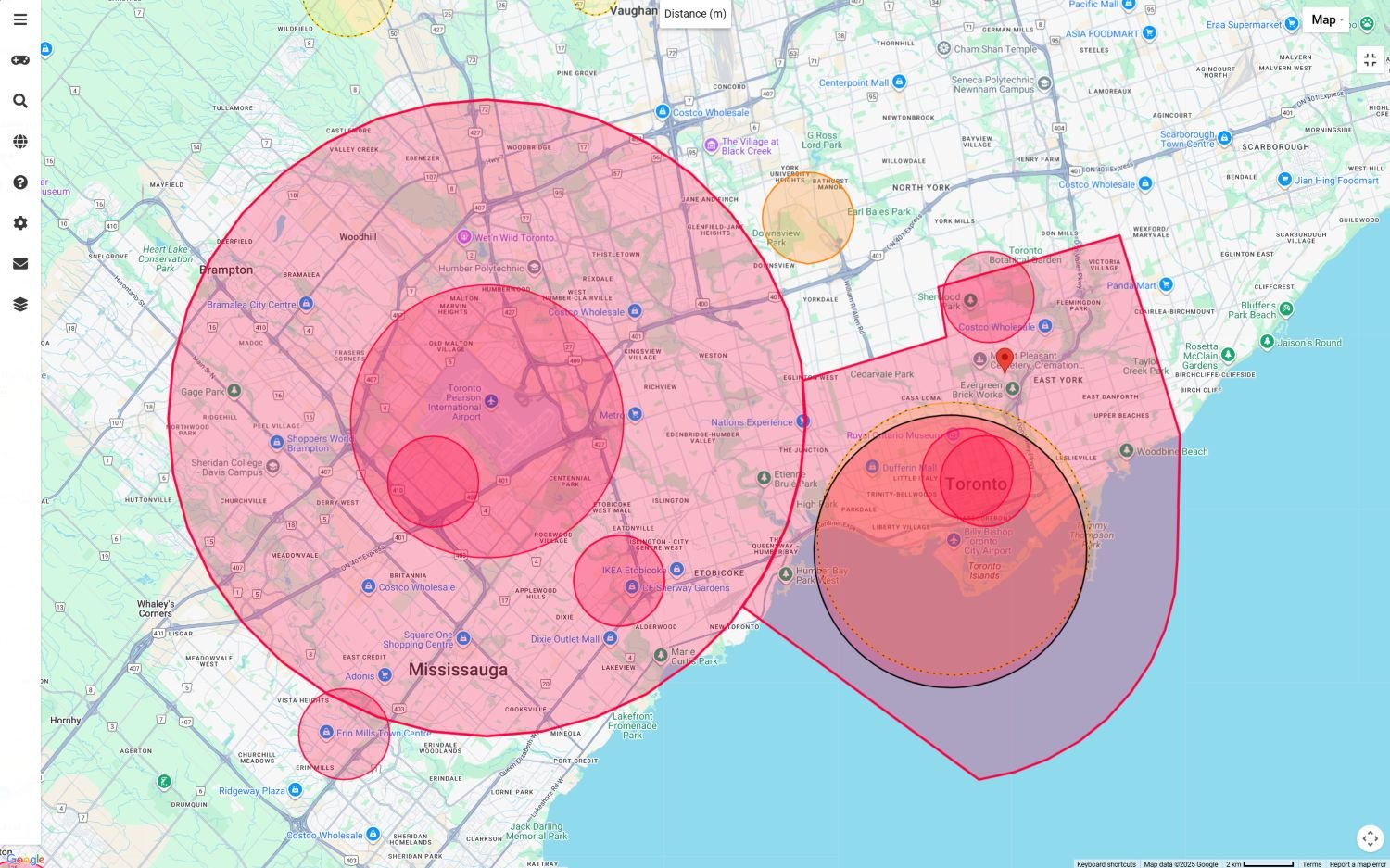
NRC Drone Site Selection Tool Showing Controlled Airspace in Toronto, Ontario
What About Micro-Drones (<250 g)?
Micro-drones do not require NAV Drone authorization, but they are not exempt from:
Toronto’s takeoff and landing bylaws
Privacy laws and Criminal Code offences
Rules prohibiting flights over people and open-air assemblies
The 2025 “advertised event” rule (SFOC required even for sub-250 g)
Flying a 249 g drone downtown without a legal place to launch is still illegal.
Pro Tip: Even though micro drones don’t require NAV Drone authorization, you can still submit a voluntary flight notification. This doesn’t grant permission to fly, but it lets you see other approved RPAS activity in the area, including police, film, news, and commercial operators, which helps avoid airspace conflicts in dense areas like downtown, near hospitals, or along the waterfront.
Where You Can and Can't Launch a Drone in Toronto
The biggest challenge in Toronto isn’t airspace, it’s finding a legal place to take off and land. Transport Canada regulates what happens in the air, but the City of Toronto controls what happens on the ground. This is where most compliance issues arise, even for pilots who have their airspace authorization in order.
Where Drone Launching Is Explicitly Banned
Toronto Municipal Code Chapter 608 – Parks prohibits launching, landing, or operating a drone in any City-owned:
Park
Beach
Trail or ravine
Waterfront green space
The City confirms this publicly on its website:
“All city parks are ‘no drone zones’ for recreational use. Please leave your drone at home.”
— City of Toronto Parks & Trails Rules Page
There is no recreational drone permit system for parks in Toronto, and the rule applies even to micro drones under 250 g.
Where Drone Launching Is Allowed, If You Have Permission
Private property (home, business, industrial site, marina, etc.)
Construction sites, inspection sites, or film sets where you control the land
Commercial locations operating under a Film Office or site control permit
Launching is legal only if you obtain permission from the landowner and meet all federal RPAS requirements.
Areas That Are Not Explicitly Banned, But Not Automatically Legal
These locations are not covered by the Parks bylaw, but still require lawful site control:
Sidewalks, boulevards, road shoulders
Condo rooftops, hotel terraces, parking lots
Hardscaped waterfront areas not classified as “parks”
If you don’t legally control the land, you cannot assume the site is permitted, even if the location is outside a park.
Flying Over Lake Ontario and the Toronto Waterfront
Flying over water does not remove your legal obligations. Parts of Toronto’s shoreline fall inside the Billy Bishop Class C control zone, but the airspace boundary ends just east of Silver Birch Beach — meaning some beaches further east are outside controlled airspace.
However, airspace legality and launch site legality are separate issues. Even if the airspace is unrestricted, the City still bans drone takeoff and landing on all park-managed beaches and waterfront areas.
If your drone weighs 250 g or more and you are inside controlled airspace, you must have:
| Requirement (≥250 g drone) | Needed? |
|---|---|
| Advanced RPAS Certificate | ✅ Required |
| RPAS Safety Assurance (for controlled airspace) | ✅ Required |
| NAV Drone authorization | ✅ Required |
| A legal takeoff/landing site | ✅ Always required |
Legal examples:
• Survey or inspection launched from private marina property
• Film shoot operating under a City permit
• Construction or industrial shoreline work with landowner permission
Not legal:
• Launching from Woodbine Beach, Kew Gardens, Sunnyside, Humber Bay, or any other City-owned beach or park.
• “Quick launch from the rocks / pier / car” if the land is City owned and you do not have written permission.
Downtown Toronto: Understanding the Restrictions
Flying a drone in downtown Toronto is very different from flying in the suburbs or rural areas. The downtown core sits inside Class C controlled airspace, is surrounded by heliports and high-density development, and is governed by strict City land-use restrictions.
The three main barriers to legal downtown flight:
Controlled airspace → Requires Advanced Certificate, RPAS Safety Assurance, and NAV Drone authorization for any drone ≥250 g
Limited legal launch sites → Parks and waterfront green space are banned by the City, and most other land is privately owned or requires written permission
High population density → Flying over people, vehicles, or open-air assemblies is prohibited without an SFOC
Even if the airspace approval is granted, the flight is still illegal if the takeoff/landing location is not lawful.
Can You Fly a Micro-Drone Downtown?
Technically yes — but only if all other legal requirements are met.
A micro-drone (<250 g) does not require a pilot certificate or NAV Drone authorization, but it is still subject to:
| Rule | Applies to Micro RPAS? |
|---|---|
| Allowed in controlled airspace without NAV Drone | ✅ Yes |
| Allowed to launch from City parks or beaches | ❌ No |
| Allowed over crowds, parades, or festivals | ❌ No (SFOC required as of Apr 1 2025) |
| Exempt from privacy laws or Criminal Code | ❌ No |
| Exempt from CAR 900.06 (negligent operation) | ❌ No |
Reality:
A micro drone can only be flown legally downtown if launched from private property with written permission, kept within visual line of sight, and not flown over people or event zones.
A lighter drone removes the certification requirement - not the land use, safety, or enforcement rules.
Certification, Registration, and Insurance Requirements
When You Need a Pilot Certificate
If your drone weighs 250 g or more, you must hold a Transport Canada RPAS Pilot Certificate — either Basic or Advanced.
However, almost the entire City of Toronto is Class C controlled airspace, which means:
| Certificate Type | Where It Can Be Used in Toronto |
|---|---|
| Basic Certificate (Basic Operations) | ❌ Cannot be used in controlled airspace, which covers most of the city |
| Advanced Certificate (Advanced Operations) | ✅ Required for controlled airspace, including Pearson, Billy Bishop, lakefront, and downtown core |
| No Certificate (Micro RPAS) | ✅ Allowed under Part IX rules, but bylaws and 2025 event rules still apply |
Drone Registration Rules
| Drone Weight | Registration Required? | Marking Required? |
|---|---|---|
| Under 250 g (Micro RPAS) | ❌ No | ❌ No |
| 250 g – 25 kg (Small RPAS) | ✅ Yes | ✅ Yes — registration number must be visible |
| 25 kg – 150 kg (Medium RPAS) | ✅ Yes | ✅ Yes — plus Safety Assurance & 2025 LC1 requirements |
Registration is a federal requirement, not a Toronto requirement, and does not grant permission to fly in parks, downtown, or controlled airspace.
Insurance Requirements for Commercial Operations
Transport Canada does not require insurance for recreational flying, but insurance is mandatory or expected for most commercial or client-based operations — especially in dense urban or waterfront areas.
| Operation Type | Typical Required Liability Coverage |
|---|---|
| Small business / real estate media | $1M – $2M |
| Film, construction, infrastructure, or corporate work | $2M – $5M |
| Downtown, waterfront, high-risk, or city-permitted sites | $5M+ |
The City of Toronto requires $2M minimum to issue a film or road occupancy permit involving drones.
Fines and Penalties for Unauthorized Drone Activities
Drone regulations in Toronto are enforced at multiple levels; federal, municipal, and in some cases, under the Criminal Code. Fines can apply to both the pilot and the company or client benefiting from the flight, and multiple violations can be charged at the same time.
Federal Penalties (Transport Canada / CARs Part IX)
Transport Canada enforces aviation regulations under the Aeronautics Act and the Canadian Aviation Regulations (CARs). Violations may include:
Flying without the required RPAS pilot certificate
Operating a drone that is not registered or properly marked
Flying in controlled airspace without authorization
Flying in a reckless or negligent manner (CAR 900.06)
Flying over people or advertised events without an SFOC
Failing to produce documentation when requested by an inspector or police officer
Fines may be issued per violation, and more than one violation may apply to a single flight.
Municipal Penalties (City of Toronto Bylaws)
The City of Toronto enforces land use violations separately from aviation law. The most common bylaw infraction comes from:
Operating, taking off, or landing a drone in a City park or public space without a permit.
This applies to all drones, including micro-drones under 250 g.
Other potential bylaw breaches include:
Launching or landing from sidewalks, roadways, or TTC property
Obstructing public space or creating a safety risk
Filming or commercial activity without required municipal permits
Criminal and Privacy-Related Penalties
If a drone is used in a way that endangers people, violates privacy, or interferes with emergency services, federal aviation charges may be accompanied by Criminal Code violations, such as:
Mischief or interference with property
Voyeurism or surveillance without consent
Interference with emergency operations (police, medical, media, search and rescue)
Causing danger to aircraft or the public
How to Fly Legally in Toronto: Step-by-Step Guide
For Small RPAS (250 g or heavier):
Get certified: Obtain Advanced RPAS Pilot Certificate through Transport Canada’s website.
Register aircraft: Complete Transport Canada registration and mark your drone with the registration number
Verify airspace: Use the NRC Drone Site Selection Tool to confirm you're in controlled airspace
Request authorization: Submit a request through the NAV Drone app (allow processing time)
Secure launch site: Obtain written permission from private landowner OR apply for City Film Office permit if working on public land
Obtain insurance: Carry appropriate liability coverage ($2M minimum for City permits)
Plan flight: Create site survey and safety plan considering people, property, obstructions, privacy, and emergency procedures
Document everything: Carry certificate, registration, authorization approval, and landowner permission
For Micro RPAS (under 250 g):
Verify weight: Ensure total takeoff weight including all accessories is under 250 g
Check location: Confirm launch site is not City property (no parks, beaches, sidewalks, public plazas)
Avoid events: No flying over advertised events without SFOC (as of April 2025)
Follow safety rules: Maintain visual line of sight, avoid people, respect privacy
Get permission: Secure written permission if launching from private property you don't own
Where to Find Official Rules and Support
Official Regulatory Information
| Resource | Purpose |
|---|---|
| Transport Canada – Drone Safety Portal | Official regulations, pilot certification, aircraft registration, 2025 rule updates |
| NAV Drone (NAV CANADA) | Required platform for requesting controlled airspace authorization, including Pearson, Billy Bishop, and the Toronto waterfront |
| NRC Drone Site Selection Tool | Government map showing airports, heliports, airspace classes, and RPAS flight restrictions |
| City of Toronto Film & Parks Permit Portals | Confirms municipal restrictions and outlines permit workflows for commercial or film operations |
The most up-to-date federal RPAS rules are published on Transport Canada’s website, and pilots are expected to rely on those official sources — not DJI apps, forums, or YouTube tutorials.
Training and Professional Support
If your drone weighs 250 g or more and you plan to fly in Toronto, formal training is strongly recommended, especially if you are pursuing an Advanced RPAS Certificate or intend to fly Advanced Operations in controlled airspace.
Typical RPAS ground school content includes:
Canadian air law and CARs Part IX
Airspace classifications and navigation charts
Weather and NOTAM interpretation
RPAS human factors and emergency procedures
Flight safety, site survey, and operating checklists
SFOC requirements and advanced-use case planning
Several national organizations provide support, advocacy, and industry standards for Canadian drone pilots, including the Drone Pilot Association of Canada (DPAC) and Aerial Evolution Association of Canada (AEAC).
Conclusion
Operating a drone in Toronto requires more than choosing the right equipment. The city combines controlled airspace, dense population zones, and strict land-use bylaws, which means pilots must comply with both federal aviation rules and municipal property regulations before every flight. Certification, aircraft eligibility, airspace authorization, and a lawful takeoff and landing site all need to be in place for a flight to be considered legal.
Whether flying for work or recreation, the safest approach is to treat Toronto as a high-regulation environment and plan accordingly. By staying current with Transport Canada requirements, respecting City of Toronto bylaws, and confirming permissions in advance, drone pilots can operate responsibly while helping maintain safe and accepted use of drones within the city.
The reality is simple: Toronto's drone regulations are complex by design — they exist to protect public safety in one of Canada's busiest airspaces. But complexity doesn't mean it's impossible. It just means you need to do your homework, respect the rules, and plan every flight with both layers of regulation in mind.
Flying in Toronto Is Tough. We Make It Easy.
Feeling overwhelmed? You're not alone. The line between a legal flight and a $5,000 fine is razor thin, and the regulations change regularly.
If you're a professional who needs drone work done right, without the regulatory risk, don't guess.
For Businesses
Do you need cinematic aerials, construction progress tracking, thermal inspections, or building envelope surveys? We're fully insured, Advanced-certified, and handle all NAV Drone authorizations and City permits so you don't have to.
Get a Quote for Our Drone Services →
About the Author
Craig Holland is a Transport Canada Advanced RPAS pilot and commercial drone operator based in Oakville, Ontario. As the founder of Holland Productions, he specializes in navigating the complex regulatory environment of urban drone operations across the Greater Toronto Area.
Craig holds an Advanced RPAS Certificate, RPOC (Remotely Piloted Operations Certificate), Level 1 Complex (LC1) Flight Operations Certification, and ROC-A (Restricted Operator Certificate – Aeronautical). He is also a Level 2 sUAS Certified Thermographer and holds Pix4Dmatic certification for survey-quality photogrammetry.
His work includes thermal inspections, solar panel inspections, construction documentation, aerial LiDAR, and infrastructure mapping for clients across Ontario, with extensive experience securing NAV Drone authorizations, permits, and managing complex controlled and restricted airspace operations.
Learn more at hollandproductions.ca or connect on LinkedIn.