


Thermal Roof Inspection Toronto
Drone-based infrared roof scanning for commercial and industrial properties across Toronto and the GTA. Detect trapped moisture and insulation failures before they become costly repairs.
Request a Quote →Find Hidden Moisture Before It Spreads
Toronto's commercial roofs take a beating. Freeze-thaw cycles, ice damming, and extreme temperature swings stress membrane systems year after year. Water finds its way in through failed seams, deteriorated flashing, and punctures, then sits trapped in insulation where it causes damage invisible from the surface.
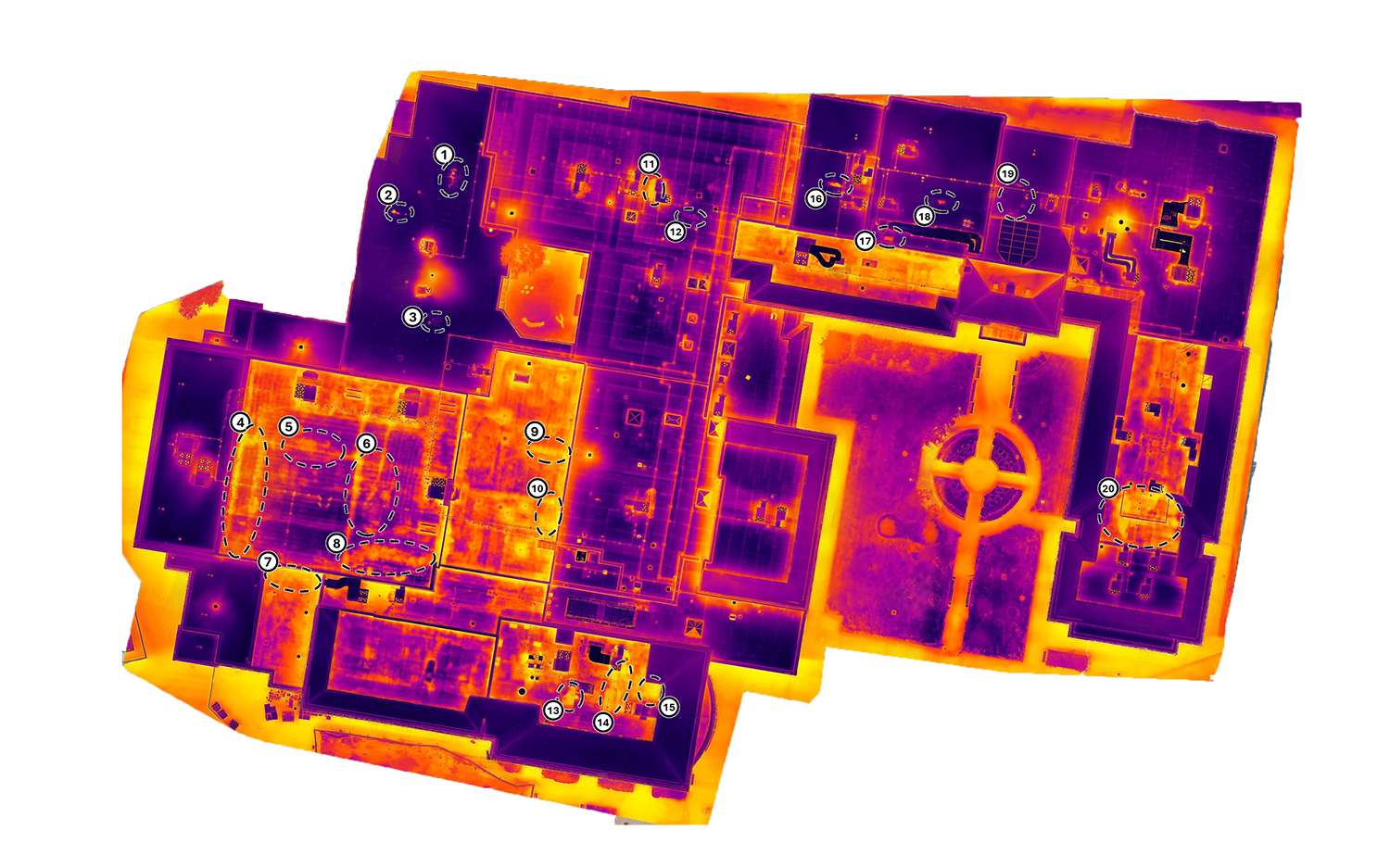
A thermal roof inspection reveals what's happening beneath the membrane. After sunset, moisture-laden insulation releases heat more slowly than dry material, creating temperature differences our infrared cameras detect and map with centimeter-level accuracy.
 Level II sUAS Certified Thermographer
How Toronto Thermal Inspections Work
Weather Coordination
We schedule for optimal conditions: 48+ hours without rain, sunny day for solar loading, clear evening, wind below 25 km/h.
RGB Survey
Daytime flight captures high-resolution imagery showing surface conditions, ponding, debris, and visible damage.
Thermal Survey
After sunset, we capture thousands of infrared images as the roof releases stored heat, revealing moisture patterns.
Processing & Delivery
We process both datasets, trace anomalies in AutoCAD, calculate affected areas, and deliver your complete documentation package.
Typical Timeline: On-site 1 to 2 hours (RGB) + 2 to 4 hours (thermal) | Report delivery: 5 to 7 business days
Commercial-Grade Thermal Systems
DJI Mavic 3 Enterprise Thermal (M3T)
Integrated thermal and visual sensors with RTK positioning for centimeter-level accuracy. Ideal for mid-size commercial roofs.
DJI Matrice 400 with H30T
Heavy-lift platform for large industrial facilities. Advanced thermal payload with extended flight time for comprehensive coverage.
32-Bit Radiometric Processing
All thermal data captured as calibrated radiometric files and processed into georeferenced maps with actual temperature data.
Deliverables
RGB Orthomosaic
High-resolution visual map of surface conditions, ponding, and defects
Radiometric Thermal Map
Georeferenced infrared orthomosaic with calibrated temperature data
AutoCAD Drawings
Anomalies traced and measured with square footage calculations
Raw Image Files
Complete RGB and infrared image sets from both surveys
Toronto Coverage
We serve commercial properties throughout Toronto, from downtown high-rises to industrial facilities across the city. NAV Canada coordination for Pearson airspace is handled as part of every project.
Also Serving
For large industrial or commercial facilities, we travel throughout Southern Ontario.
Thermal Roof Inspection Toronto
How much does a thermal roof inspection cost in Toronto?
Pricing depends on roof size, complexity, access requirements, and deliverables needed. Contact us with your roof's approximate square footage and location for a custom quote. Many clients find that targeted repairs based on thermal data cost significantly less than full roof replacement.
How long does a thermal inspection take?
On-site work typically runs 3 to 6 hours total: a daytime RGB survey (1 to 2 hours) followed by an evening thermal scan (2 to 4 hours depending on roof size and required resolution). Report delivery takes 5 to 7 business days.
What weather conditions do you need?
Thermal scans require specific conditions: at least 48 hours without rain, a sunny day to heat the roof (solar loading), clear evening skies, and wind speeds below 25 km/h. We monitor weather closely and schedule backup dates for every project.
What types of roofs can you scan?
Flat and low-slope commercial roofs with membrane systems produce the best results: TPO, EPDM, modified bitumen, and built-up roofing. Steep-slope residential roofs with shingles or tiles typically are not suitable for thermal moisture detection.
Can thermal imaging detect active leaks?
Thermal imaging detects moisture that has accumulated in roofing insulation over time. It reveals where water has entered and spread, but may not pinpoint the exact entry point of very recent leaks. We recommend pairing thermal data with targeted core samples for verification before major repairs.
Do you follow ASTM standards?
Yes. Our thermal roof surveys follow ASTM C1153 protocols for locating wet insulation using infrared imaging. This produces results that roofing consultants, engineers, and insurance companies recognize.
Are you licensed for drone operations in Toronto?
Yes. Holland Productions holds Transport Canada Advanced RPAS certification and RPOC authorization for complex operations. We carry $6.25 million in commercial liability insurance. Toronto Pearson airspace requires NAV Canada coordination, which we handle as part of every project.
How is drone thermal scanning better than walk-over scanning?
Ground-based scans capture thermal data at an angle, which reduces accuracy. Our drone-based approach captures imagery straight down (nadir), perpendicular to the roof surface, producing more reliable temperature readings. We also map the entire roof systematically rather than sampling specific areas.
Schedule Your Toronto Thermal Inspection
Find hidden moisture before it becomes a costly repair. Our infrared surveys give you the data to make informed decisions about your roof.
Request a Quote →Phone: 1-416-797-4870
Email: info@hollandproductions.ca